Key takeaways
- Define occasion and underlayers before material approval.
- Check closure and hem during movement.
- Do not describe one silhouette as suitable for every body.
Give each dress a clear buying reason
Separate everyday, work and occasion directions where those distinctions matter to your customer. A decorative change may not justify another SKU if the same fit and use are already covered. Select diversity in useful design decisions rather than a pile of near-identical images.
Without actual sales data, avoid labels such as proven seller. Use an editorial reason: a different closure, sleeve, material route or wearing occasion. That is a transparent basis for sampling.
Locate the waist and the movement
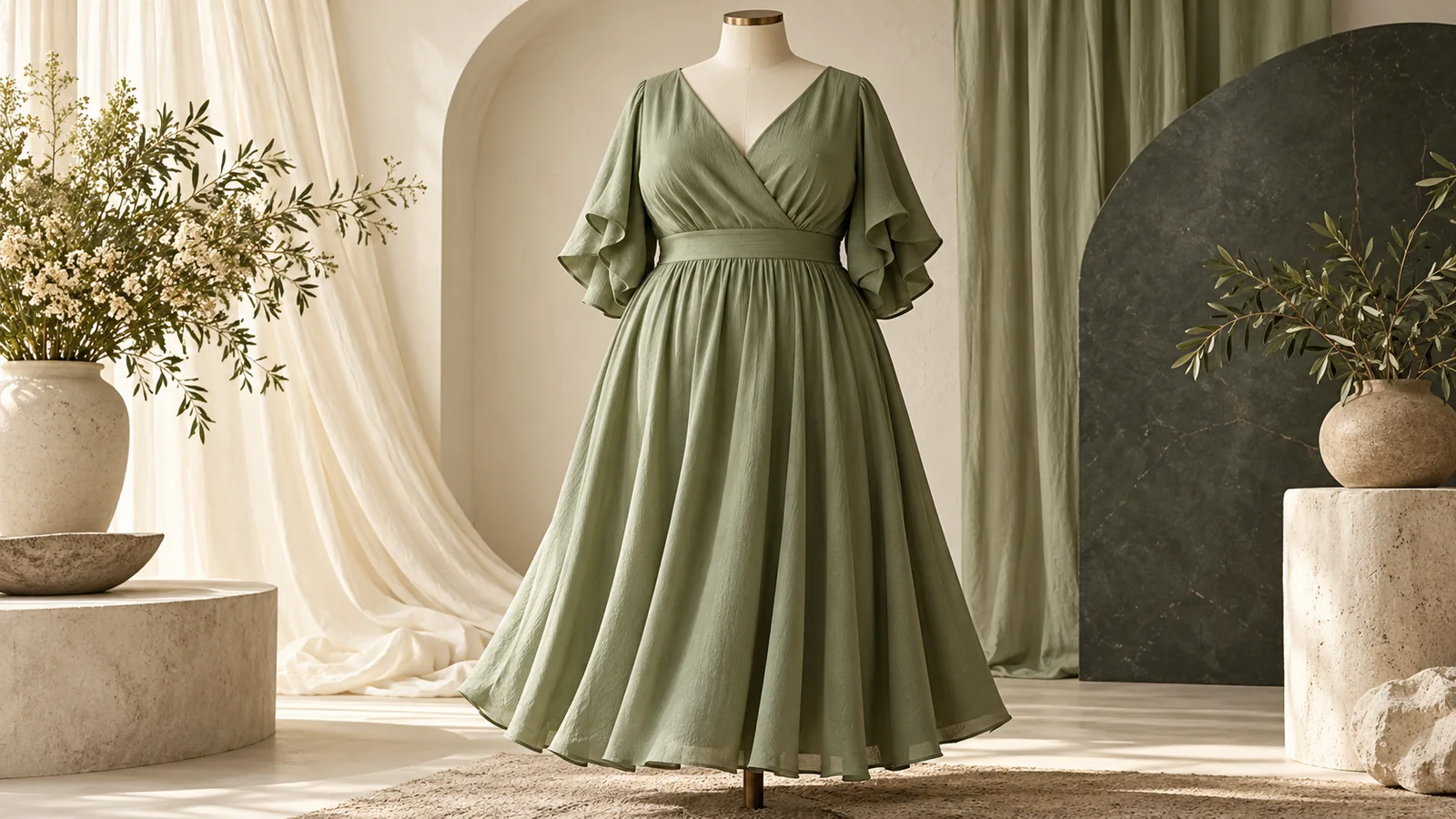
A waist seam, belt or shaping line should be evaluated against the intended proportions. Do not assume its position from a styled photograph. Review sitting and walking, and observe whether the garment shifts or restricts in a way that conflicts with the brief.
Consider sleeve and armhole interaction as well as torso room. A generous skirt does not compensate for an upper sleeve that prevents comfortable reach. Document each area rather than giving a global instruction to make the dress bigger.
Review coverage and construction together
Check the proposed colour and material in relevant lighting and movement. If lining is needed, specify its extent and relationship to the shell. A wrap, slit or button opening needs its own coverage review.
Ask for clear images of actual details, but do not turn missing imagery into invented structure. If the back is unknown, label it as a development decision pending. The Coats: Soft and Secure Seams reference supports considering seam requirements; it does not validate the garment shown in a catalogue.
Check the order implications
Print placement, directional fabric, decoration and lining can affect consumption and operations. Ask for the assumptions behind the quotation. Compare alternatives using the same brief rather than assuming that two midi dresses have comparable manufacturing requirements.
Clarify the size run and colour mix for the selected style. S–8XL is an overall development capability, not a promise that every dress is available in every size.
Prioritize the sample work
For each shortlisted dress, identify the most important uncertainty. It may be a closure, the fall of a fabric or a grading checkpoint. Request evidence targeted to that uncertainty, then evaluate the rest of the garment before release.
A strong shortlist balances commercial interest with the time needed to develop it responsibly. It should not rely on “flattering” as the sole criterion or promise a universal body effect.
Classify dresses by decision risk, not just occasion
Occasion labels can help merchandising, but they do not describe the work needed to approve a dress. Identify whether the style depends on a fitted bodice, closure, lining, overlap, gathered volume or another construction relationship. The more a design depends on a specific relationship, the more important it is to review that relationship with the actual material.
Check that available images show the full outline and relevant construction. A cropped photograph may conceal the hem, lining or closure. Do not generate an imagined back view to fill the gap. Mark the missing evidence and request a real reference before making a decision that depends on it.
Give each shortlisted dress a clear collection role. Avoid treating a different print as a wholly different fit solution when the underlying style is unchanged. At the same time, recognize that a different material or print process may require its own approval even when it belongs to the same style family.
Build a release question for every shortlisted dress
A hypothetical buyer might ask, “Can this dress meet the intended coverage and movement brief with the approved material?” That question is more useful than “Is this a good plus-size dress?” It directs the review toward observable relationships and avoids implying that one silhouette suits every person.
Review the relevant actions, underlayers and closure use. Record any design preference separately from a functional concern. A flowing silhouette may be intentional, while a lining that restricts movement may require correction. The approval notes should make that distinction clear for production.
When comparing costs, include the construction and finishing actually required, not only the shell material. If a lower-priced alternative changes lining, closure or detail, identify the trade-off explicitly. Select the version that meets the brief and keep the agreed reference attached to the order rather than relying on the original inspiration image.
Decision checklist
| Checkpoint | Question | Next evidence |
|---|---|---|
| Occasion | Where and how will it be worn? | Customer brief |
| Waist and length | Are positions intentional? | Measured sample |
| Closure and coverage | What happens during movement? | Relevant fitting |
| Material and lining | Does the assembly meet the brief? | Physical material and garment review |
Frequently asked questions
Should every dress be lined?
No. Decide from coverage, finish, comfort and the intended use.
Can a belt solve an incorrect waist position?
Not automatically; it may change distribution without correcting the underlying pattern.
Is a midi length a fixed measurement?
No. Specify the finished length and the intended reference rather than relying on the style word.
Can one sample validate all printed colours?
Not necessarily. Colour, ground coverage and production differences may require additional review.
Sources & scope
- Coats: Soft and Secure Seams
Seam design considerations; no product certification inferred. Publication date not stated. Checked 23 October 2026.
Your next step
Explore dress concepts →For your collection, confirm the style’s size chart and specifications. S–8XL is an overall development range, not a US size conversion.
Browse styles · Development services