Key takeaways
- Review seated comfort and entry.
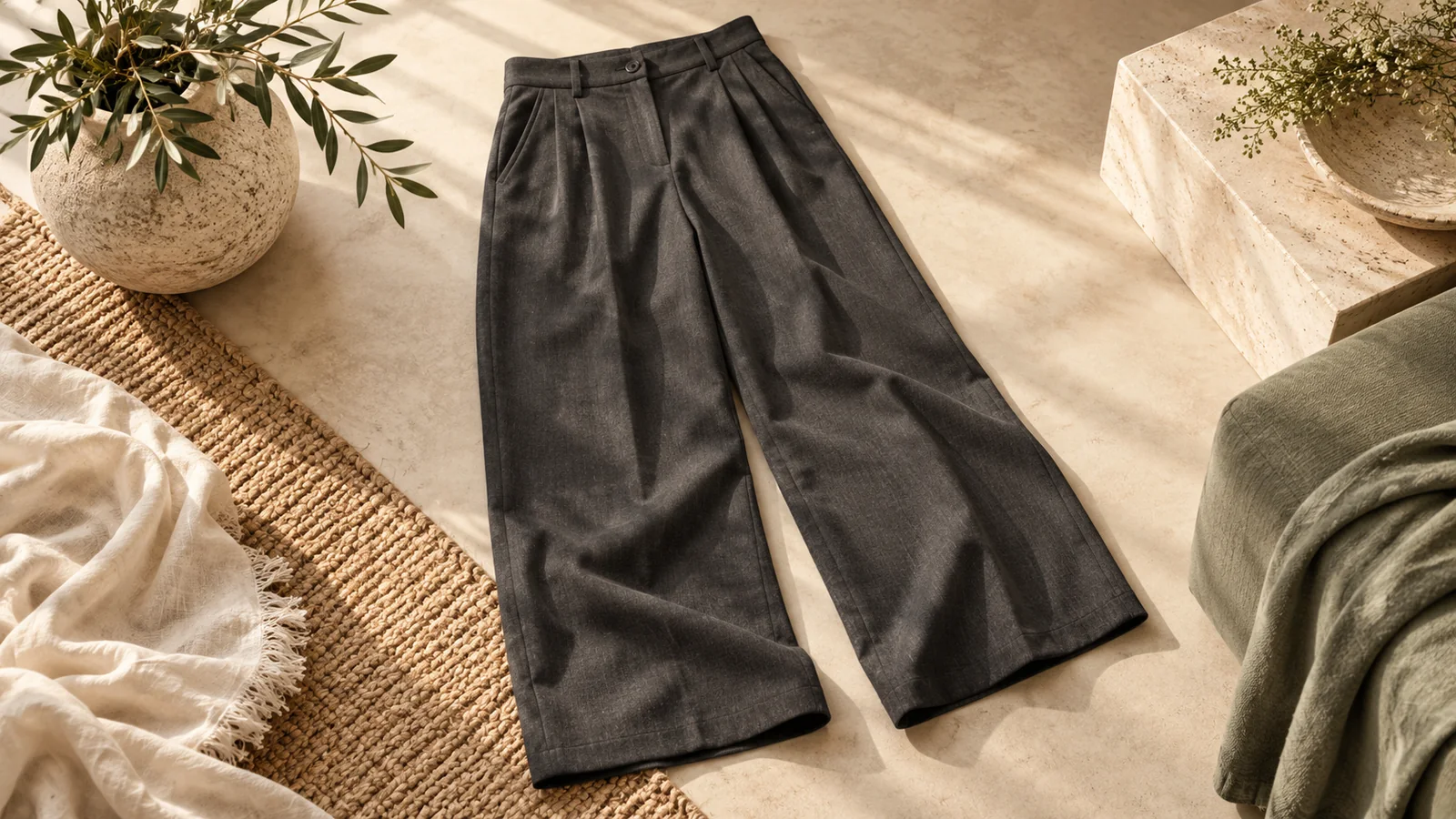
- Check the whole leg and hem in imagery.
- Keep waistband and fabric performance claims evidence-based.
Define the trouser’s purpose
State whether the product is relaxed tailoring, casual everyday wear or another specific direction. Identify intended footwear, length and wearing conditions. “Wide leg” describes a visual direction, not the rise, seat shape or waistband construction.
Compare candidates by meaningful differences. A pocket treatment, rise relationship or material route may justify another sample; a new colour alone does not create a different style for the assortment plan.
Check the proportion map
Request waist, hip, rise, inseam and relevant leg measurements with methods. Make clear whether waist values are relaxed or extended and whether widths are flat or circumferential. The existing measurement guide provides the general distinction; the trouser brief needs style-specific points.
Review front and back balance. A correct waist figure cannot establish comfort at the seat or crotch. Do not infer the back construction from an attractive front image or generate an unsupported reverse view for approval.
Review movement and functional details
Ask for sitting and walking observations on the intended sample. Record pressure, pulling, slipping or unwanted displacement neutrally. Check pocket access and whether contents change the garment’s appearance or comfort under the intended use.
Review closure, waistband, hem and any lining together. If fabric extension is important, obtain method-defined evidence rather than assuming it from fibre percentage. The LYCRA Company: Quality FAQ is terminology background, not proof of a particular trouser’s performance.
Consider care and continuity
A trouser that fits before care may change in length or balance afterward. Include relevant dimensional and appearance review. If the fabric or finish changes on a reorder, decide which checks need repeating.
For coordinated ranges, ask how shade continuity is managed between tops and bottoms. A similar colour name does not guarantee a match across materials or lots. Keep physical references and approval conditions clear.
End with a sample decision
Write a concise development request containing the chosen silhouette, body reference, garment points, fabric option and main unresolved risk. Do not ask the supplier to solve an undefined fit by merely sending the largest available size.
The result should be a shortlist you can defend: why each trouser serves the customer, what evidence is missing and what would cause you to reject it. That is more useful than a list ranked by photographs alone.
Review the rise, seat and leg as connected decisions
A trouser cannot be evaluated adequately from waist and hip values alone. Ask for the defined measurement points and review the intended wearing position, rise relationship and leg silhouette. Measurements are part of the evidence; they do not independently establish comfort while seated or moving.
Check whether the source image actually shows the waistband and hem. Styling that covers the waist may be attractive for a campaign but insufficient for a buyer’s technical selection. Request a relevant reference instead of inferring pocket placement, closure or waistband construction from an incomplete view.
Consider the material and assembly together. A change in stretch, weight or finishing can affect how the same pattern behaves. Do not call a material suitable for trousers merely because it is described as stretchy. Identify the intended use and request evidence for the properties that matter to that use.
Create a focused trouser sample review
For a hypothetical shortlist, assign each trouser a distinct purpose and identify its main uncertainty. A structured work style may need attention to closure and seated balance; a relaxed style may raise questions about waistband behaviour or leg volume. These are examples of review priorities, not universal rules for the categories.
During sampling, record walking and sitting observations in neutral language. Note where the garment shifts, pulls or bunches, and let the technical team investigate the cause. Do not prescribe a generic rise increase or width change solely from a front photograph.
Before release, verify that the revised specification, sample and material references agree. If the buyer approves only one checkpoint size, state what remains to validate across the intended run. A well-organized trouser selection process makes uncertainty visible rather than hiding it behind an attractive model image.
Decision checklist
| Area | Check | Evidence gap to flag |
|---|---|---|
| Waist | Construction, entry and seated behaviour | Unknown relaxed/extended method |
| Rise and seat | Balance during movement | Missing back view or fit record |
| Leg | Thigh, shape, inseam and hem | Cropped product image |
| Material | Relevant extension and care behaviour | Unverified performance wording |
Frequently asked questions
Can a waist chart determine trouser fit?
It is one input; seat, rise, leg and movement also matter.
Should all sizes have the same inseam?
That is a design and grading decision to document, not an automatic rule.
Can pockets be added after sample approval?
Treat the addition as a construction change and review its effects.
Is a seated photograph enough?
It supports observation but does not replace measurements and wearer feedback.
Sources & scope
- The LYCRA Company: Quality FAQ
Terminology and branded-fibre distinction; no claim our fabrics contain branded fibre. Publication date not stated. Checked 23 October 2026.
Your next step
Explore trouser development options →For your collection, confirm the style’s size chart and specifications. S–8XL is an overall development range, not a US size conversion.
Browse styles · Development services