Key takeaways
- Construction is not the same as fibre composition.
- A stretch requirement needs evidence in either category.
- Compare garment assemblies, not isolated fabric prices.
Begin with construction, then specify the article
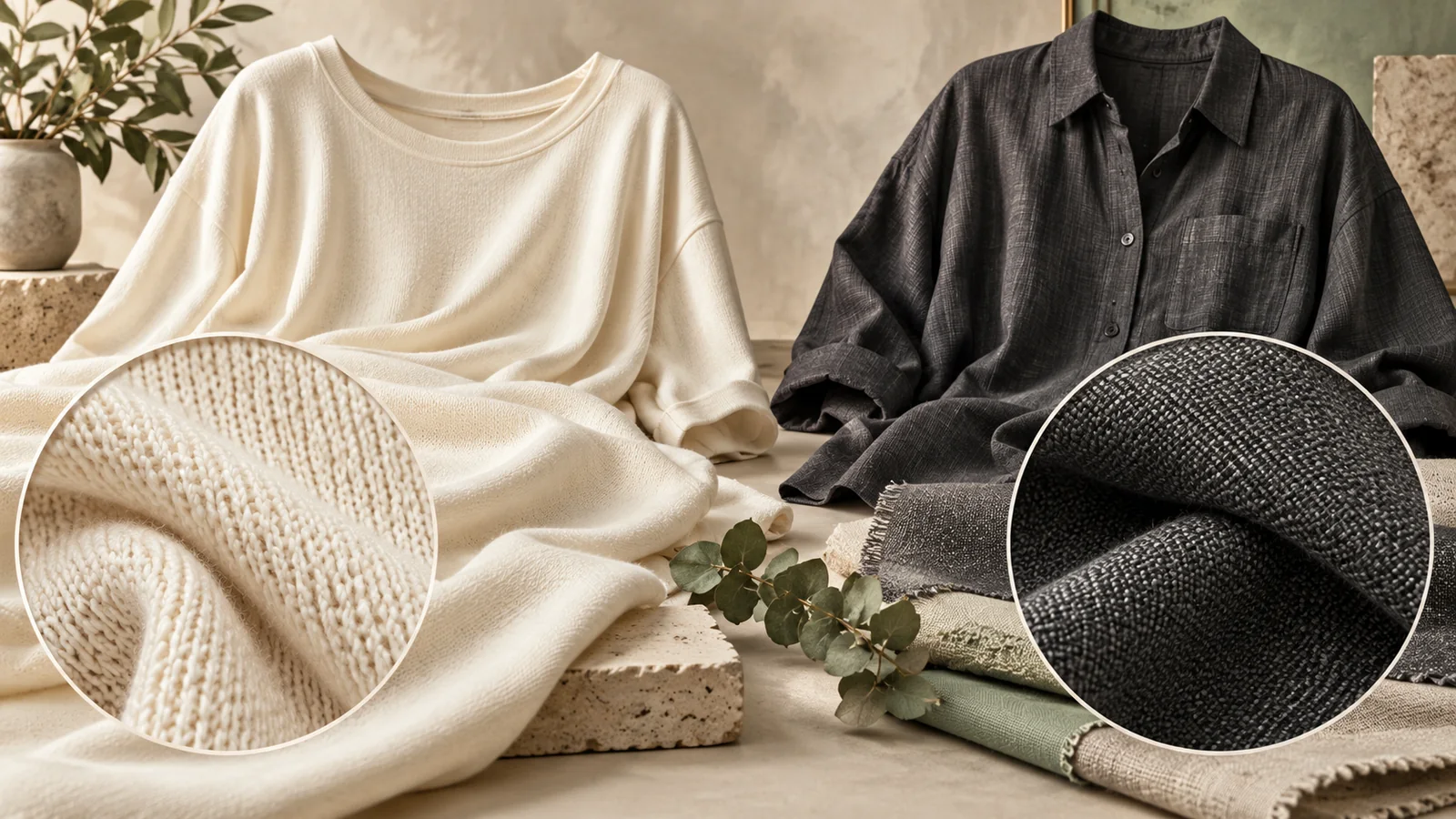
Knitted structures use loops; woven structures interlace yarn systems. Those broad descriptions do not establish the behaviour of every article. The CottonWorks: textile learning hub hub is a useful terminology reference. A compact knit and a fluid woven can overlap in some visual qualities while behaving differently at edges, seams and under load.
Ask for composition, construction, finish, usable width and relevant test evidence. Avoid buying “jersey” or “woven” as if either word were a complete material specification.
Compare the wearing brief
A relaxed everyday top may benefit from a knit’s particular movement and handle, while a crisp shirt may need a different structure. Those are design possibilities, not universal rules. A woven with suitable engineered stretch may also support movement; a knit can still restrict if its construction or garment pattern is inappropriate.
Review shoulder balance, armholes, closures and hem behaviour in the assembled sample. Do not transfer a pattern unchanged between constructions and assume the same fit. The appropriate allowances and finishing may differ.
Compare the work required
List the actual operations: cutting, edge handling, stabilization, seams, closures and pressing. A seemingly simpler material can create extra work in an unfamiliar construction. Ask the supplier which assembly decisions are needed and what sample evidence supports them.
Include care and dimensional stability in the comparison. CottonWorks: Shrinkage & Skewing provides background on processing-related stability questions, but does not establish results for either candidate in your project. Have the relevant options assessed rather than assigning a generic shrinkage figure.
Use a controlled sample comparison
Select one intended silhouette and request clearly identified samples. Document any pattern changes needed for each material. Otherwise, the comparison may be between different designs rather than different material routes.
Rank the options against your actual priorities: movement, structure, coverage, care, appearance and cost. Weight these priorities explicitly. Do not give every field equal importance if one is a non-negotiable requirement. A lowest-cost option that fails the core use is not the best purchase.
When either route may be wrong
A very fitted silhouette, an unsupported performance claim or a difficult care requirement may need a different development approach altogether. Do not force a binary choice when neither sample works. Explain the failure to the supplier and revise the brief.
The final selection should name the actual material and approved assembly. FORMIVA’s catalogue imagery is not evidence that a concept is available in either construction. Use the comparison to request a specific sample, not to promise interchangeable fabrics to customers.
Compare the complete construction route
Ask each supplier to quote the garment as designed, with the proposed material and assembly identified. Comparing a fabric price alone leaves out cutting, sewing, finishing and any supporting components. A knit and a woven version of a similar silhouette may need different patterns and production decisions. They should not be presented as interchangeable merely because the finished photographs look similar.
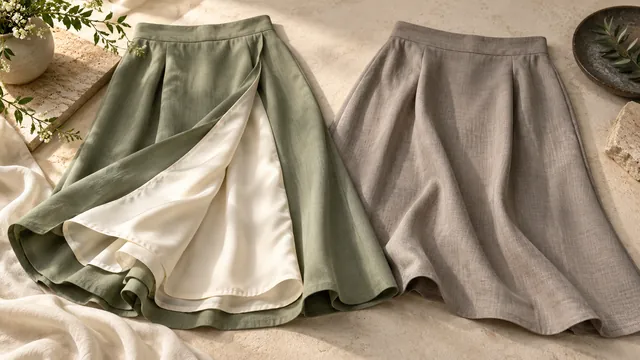
Review the intended silhouette on a suitable sample. A woven construction may support a crisp appearance, while a knit may offer another kind of movement and surface character, but neither description applies uniformly to every material. Construction, yarn, finishing and weight all affect the result. Avoid using the category name as a performance specification.
Keep a decision sheet with the desired appearance, movement, care and commercial constraints. Mark which observations come from a sample and which remain supplier proposals. This helps the buyer compare real trade-offs instead of choosing the option with the most attractive generic description.
A two-route top development exercise
Imagine a hypothetical brand developing an everyday top for a defined customer. One route uses a woven material with a closure; another uses a knit construction without that closure. The comparison should include getting the garment on and off, neckline behaviour, movement, care and the intended silhouette. It is not enough to compare the chest measurement alone.
If the buyer wants the knit version to reproduce the woven version exactly, ask whether that expectation is technically useful. The pattern and assembly may need to reflect the material rather than imitate every detail. Equally, do not change the design silently in the name of suitability; propose differences and obtain approval.
Choose the route that meets the actual priorities and document the compromise. If a new material is later substituted, revisit the decisions it affects. An approved category—“knit” or “woven”—is not an approval of every material within it.
Decision checklist
| Decision | Knit candidate | Woven candidate |
|---|---|---|
| Silhouette | Review structure and edge stability | Review fall and shape retention |
| Movement | Verify extension and recovery | Verify allowance and any stretch |
| Construction | Review seams and stabilization | Review closures and seam behaviour |
| Care | Check dimensional change | Check dimensional change and finish |
Frequently asked questions
Are all knits stretchy?
Do not assume a useful degree or direction of stretch without reviewing the actual article.
Are all wovens rigid?
No. Construction and material engineering can provide different behaviours.
Can the same pattern be used for both?
It may need revision; verify the assembled fit rather than assuming interchangeability.
Which is cheaper?
Compare material consumption and complete manufacturing requirements, not construction labels alone.
Sources & scope
- CottonWorks: textile learning hub
Construction terminology reference; purchasing recommendations are editorial analysis. Publication date not stated. Checked 23 October 2026.
- CottonWorks: Shrinkage & Skewing
Educational guidance, not predicted shrinkage for a supplied style. Publication date not stated. Checked 23 October 2026.
Your next step
Compare material routes for your style →For your collection, confirm the style’s size chart and specifications. S–8XL is an overall development range, not a US size conversion.
Browse styles · Development services