Key takeaways
- Review closure during movement, not only standing.
- Define the intended coverage and styling.
- Compare complete samples in suitable materials.
A wrap creates an overlap decision
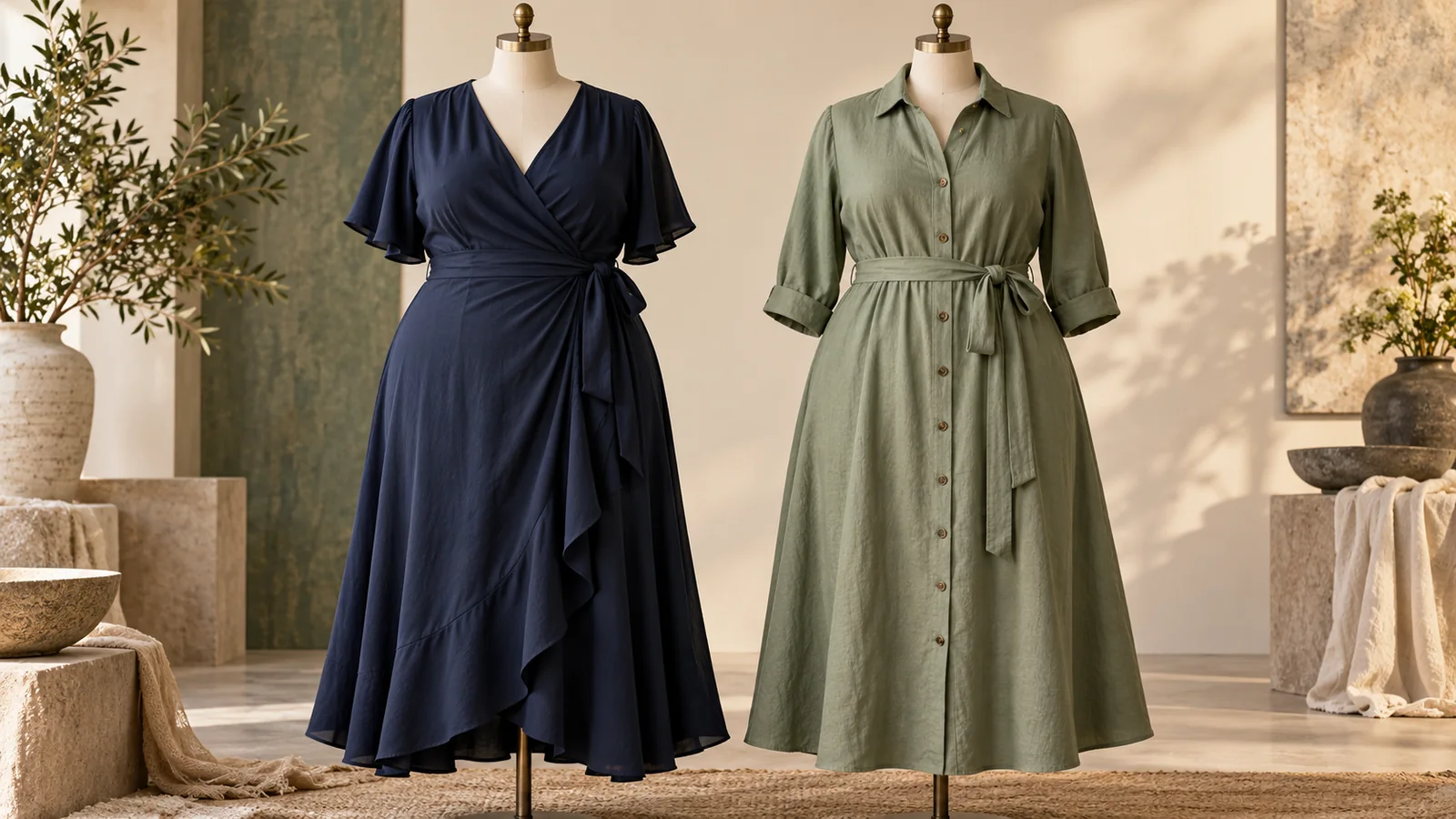
Identify whether the garment is a true wrap, a fixed mock wrap or another construction. These are not interchangeable products. A buyer must understand how it opens, how it is secured and what happens during sitting or walking.
Review the overlap at the intended body reference and in relevant sizes. A photograph with a carefully arranged pose may disguise a coverage problem. Do not use a universal overlap value without considering the garment and wearing brief.
A shirt dress creates a placket decision
Review the button and buttonhole relationship, placket stability, bust room and seated behaviour. If an opening spreads, investigate the cause before simply adding more buttons. The issue may involve pattern distribution, material or the intended silhouette.
Consider whether the dress is meant to be worn belted, loose or both. A belt changes how fabric is distributed and can affect length or opening behaviour. Make the approved styling condition explicit.
Material changes the comparison
A fluid material can behave differently from a crisp one in either design. Compare actual candidates, not a visual category such as “summer dress.” Include lining, interfacing and trims where relevant so the sample reflects the assembly.
A wrap tie in a bulky fabric may need a different development approach from one in a light fabric. A placket in a delicate material may need careful construction. These are questions for sampling, not reasons to reject an entire design category.
Use a decision-based fitting
Ask participants to stand, sit and walk in the intended underlayer. Record closure security, coverage and ease of use. Keep language respectful: the purpose is to assess the garment, not to rank bodies. The ASTM D6960/D6960M-16e1: plus women’s body measurement tables (historical edition) reference concerns body measurements and does not establish which dress design a person should wear.
Check the proposed size run at appropriate points. A successful base sample does not independently establish overlap or placket behaviour throughout a broad range.
Choose the development risk you can manage
If the buying team has strong experience with one block, it may be sensible to refine that direction first. If the collection needs a different silhouette, allocate the time to develop it rather than forcing the familiar specification into a new shape.
Document the exact construction and approved use. Avoid describing every wrap dress as adjustable for any size or every shirt dress as easy-fit. The best choice is the one supported by a clear brief and an approved sample.
Compare closure behaviour rather than category appeal
A wrap dress and a shirt dress can both serve a collection, but the purchasing questions differ. For a wrap, review overlap, fastening and coverage through relevant movement. For a shirt dress, review the placket, button spacing, closure use and any tension across the front. The names alone do not tell the buyer how either style will behave on a particular customer.
Ask whether the proposed design is a true wrap, a fixed wrap appearance or another construction. These distinctions affect adjustment and use. Likewise, confirm whether the shirt-dress closure is fully functional and how the garment is intended to be worn. Product descriptions should reflect the actual construction, not a shorthand borrowed from a mood board.
Evaluate fabric and pattern together. A material change can alter overlap, drape or closure behaviour. An attractive style reference is not sufficient evidence that a new version will have the same wearing characteristics.
Plan the assortment around distinct customer uses
In a hypothetical small collection, the buyer might be considering both silhouettes. Instead of selecting near-duplicates in several colours, define the role of each: intended occasion, layering, preferred adjustment and visual character. This creates a clearer reason to carry both, without claiming that one is universally more flattering or commercially successful.
Review the proposed sizes with appropriate checkpoints. A closure that behaves acceptably at the base size may need attention elsewhere in the range. Do not rely on a model photograph to establish coverage during sitting or reaching. Ask for a controlled physical review and record the agreed result.
When deciding quantities, use actual channel evidence where available and identify assumptions where it is absent. Neither silhouette should be called a bestseller without supporting sales information. The procurement value of the comparison is understanding the development risks and customer use—not predicting demand from the category name.
Decision checklist
| Question | Wrap direction | Shirt-dress direction |
|---|---|---|
| Closure | Overlap and ties | Placket and buttons |
| Movement | Coverage while seated and walking | Gaping and restriction |
| Material | Tie bulk and fall | Placket stability and drape |
| Approval | True versus mock wrap identified | Belted versus loose use identified |
Frequently asked questions
Is a wrap dress automatically adjustable across sizes?
No. Adjustment has limits and does not replace an approved size chart.
Can extra buttons fix all gaping?
No. Investigate fit and construction before prescribing that change.
Can the same lining work in both?
It needs review in each assembly rather than automatic transfer.
Which style should a new brand launch first?
Choose based on customer brief, block experience and development resources, not a universal popularity claim.
Sources & scope
- ASTM D6960/D6960M-16e1: plus women’s body measurement tables (historical edition)
Public scope only; no paid measurement tables reproduced. Not a mapping for FORMIVA sizes. Source date: 2016; historical listing updated 2023-08-07. Checked 23 October 2026.
Your next step
Explore dress development directions →For your collection, confirm the style’s size chart and specifications. S–8XL is an overall development range, not a US size conversion.
Browse styles · Development services