Key takeaways
- Match artwork scale to the garment location.
- Assess the reverse side and contact comfort.
- Separate setup costs from repeat-unit costs.
Begin with the artwork and substrate
Identify the artwork, colours, scale and placement on the actual style. A large filled motif and a fine outline have different requirements. The fabric’s structure, surface and intended extension also matter. Ask the decoration provider which methods are suitable rather than choosing solely by a category name.
Confirm ownership or permission for all artwork. A reference image is not necessarily licensed for reproduction. Do not request another brand’s logo or protected design as a shortcut to a finished brief.
Review physical effects
Printing may alter surface feel or local behaviour depending on the process. Embroidery adds thread and may require backing or other preparation. Neither method should be described as universally more durable or premium. Inspect the actual result in the intended location.
For areas against the body, review the reverse side and any backing. For stretch zones, assess how the decorated area moves with the rest of the garment. A satisfactory loose swatch can still behave differently when placed across a curved or tensioned area.
Check scale across the size range
Decide whether the artwork remains the same physical size or changes across the range. Both can be valid design choices, but the decision should not be accidental. Specify a placement reference that remains understandable when garment dimensions change.
Avoid instructions based only on a mock-up pasted onto one model image. Provide measurable placement information and an approved visual reference. If scaling changes detail or production feasibility, review that before the order is released.
Compare complete costs and evidence
Request setup, sampling, repeat-unit and minimum conditions separately. A method with lower setup cost may not have the lowest cost at every quantity; a method with an attractive unit quote may require a material or artwork change. Compare the same agreed brief.
Use relevant care and colour-transfer assessments where needed. The AATCC: Standard Test Methods and Procedures directory is background on method selection, not evidence that a particular decoration has passed. Ask for the provider’s recommended test plan and identify the approved sample.
Approve a version that can be reproduced
Keep artwork version, dimensions, colour reference, method, placement and sample together. State whether the approval covers all proposed colours and sizes. If a provider changes backing, ink system or other relevant components, define what review is required.
The purchasing goal is not to choose the most elaborate decoration. It is to select a method that communicates the brand while preserving the intended garment performance and commercial plan.
Compare the decorated garment, not isolated artwork
Provide the artwork size, placement and intended material to the supplier before requesting a method recommendation. A design that works on one substrate or at one scale may need reconsideration on another. Ask what detail can be reproduced and what effect the application has on the garment’s hand and movement.
Request a representative strike-off or decorated sample using the intended material where feasible. A presentation image cannot establish colour, texture, durability or the reverse-side finish. For embroidery, inspect the backing and contact area; for printing, review the actual method and the characteristics relevant to the design. Do not assume all processes within either category behave identically.
Include setup, application, approval and any order constraints in the comparison. The lower unit quote may omit an initial cost or use a different size and placement. Make the basis consistent before drawing a cost conclusion.
Resolve a delicate-fabric decoration proposal
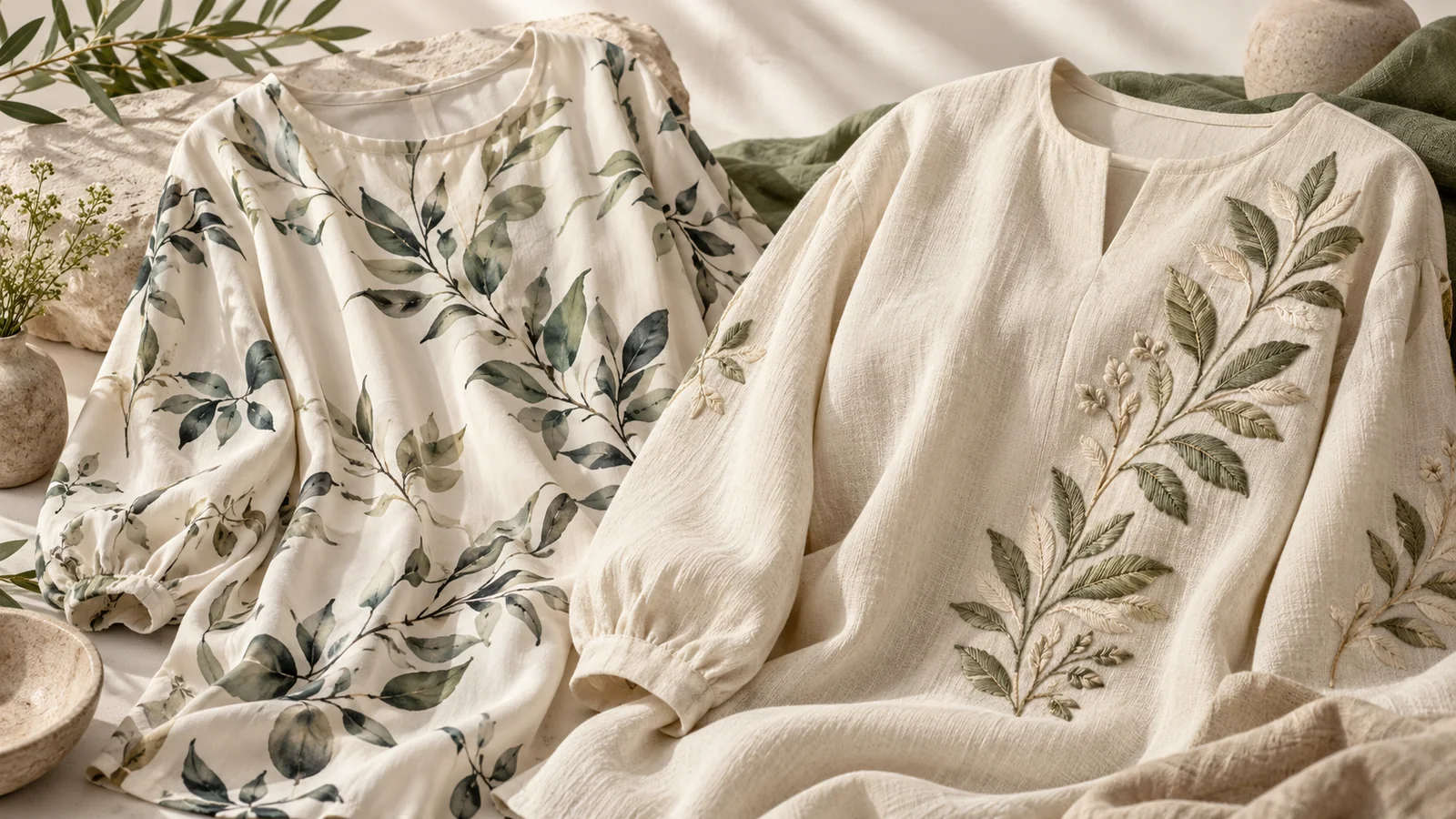
Imagine a hypothetical blouse with a detailed motif near a moving or curved area. The buyer should ask whether the proposed decoration changes drape, creates local stiffness or affects comfort. That does not make the method unsuitable; it means the assembly needs to be reviewed in context.
If the first submission loses detail, consider whether to change artwork scale, placement or process. Obtain approval for any change to the design rather than allowing the supplier to simplify it silently. Keep the final artwork file and approved sample version aligned.
After care, inspect the aspects relevant to the selected process under an appropriate procedure. Do not turn an informal handling observation into a broad durability claim. The final specification should identify the method, approved appearance and evidence required, so repeat orders do not recreate the design from an outdated screenshot.
Decision checklist
| Comparison | Embroidery | |
|---|---|---|
| Artwork | Review process and colour reproduction | Review stitch interpretation and detail |
| Hand | Assess surface effect | Assess thread and backing bulk |
| Movement | Review local extension | Review assembly restriction |
| Cost | Setup and quantity basis | Digitizing, stitch complexity and quantity basis |
Frequently asked questions
Is embroidery always longer lasting?
No universal claim is justified without the actual materials, construction and care evidence.
Can I approve from a digital mock-up?
Use it for direction, then review a physical result for material interaction.
Should artwork scale with every size?
Make a deliberate design decision and verify placement, rather than applying automatic scaling.
Can a tiny logo need sampling?
Yes, especially when fine detail, backing or a sensitive location matters.
Sources & scope
- AATCC: Standard Test Methods and Procedures
Public method directory only. Obtain licensed methods and laboratory advice before specifying tests. Publication date not stated. Checked 23 October 2026.
Your next step
Discuss artwork and decoration feasibility →For your collection, confirm the style’s size chart and specifications. S–8XL is an overall development range, not a US size conversion.
Browse styles · Development services