Key takeaways
- Do not assume one customer wears the same size on top and bottom.
- Define whether quantities count sets or pieces.
- Plan replenishment at the garment level.
Identify the customer problem
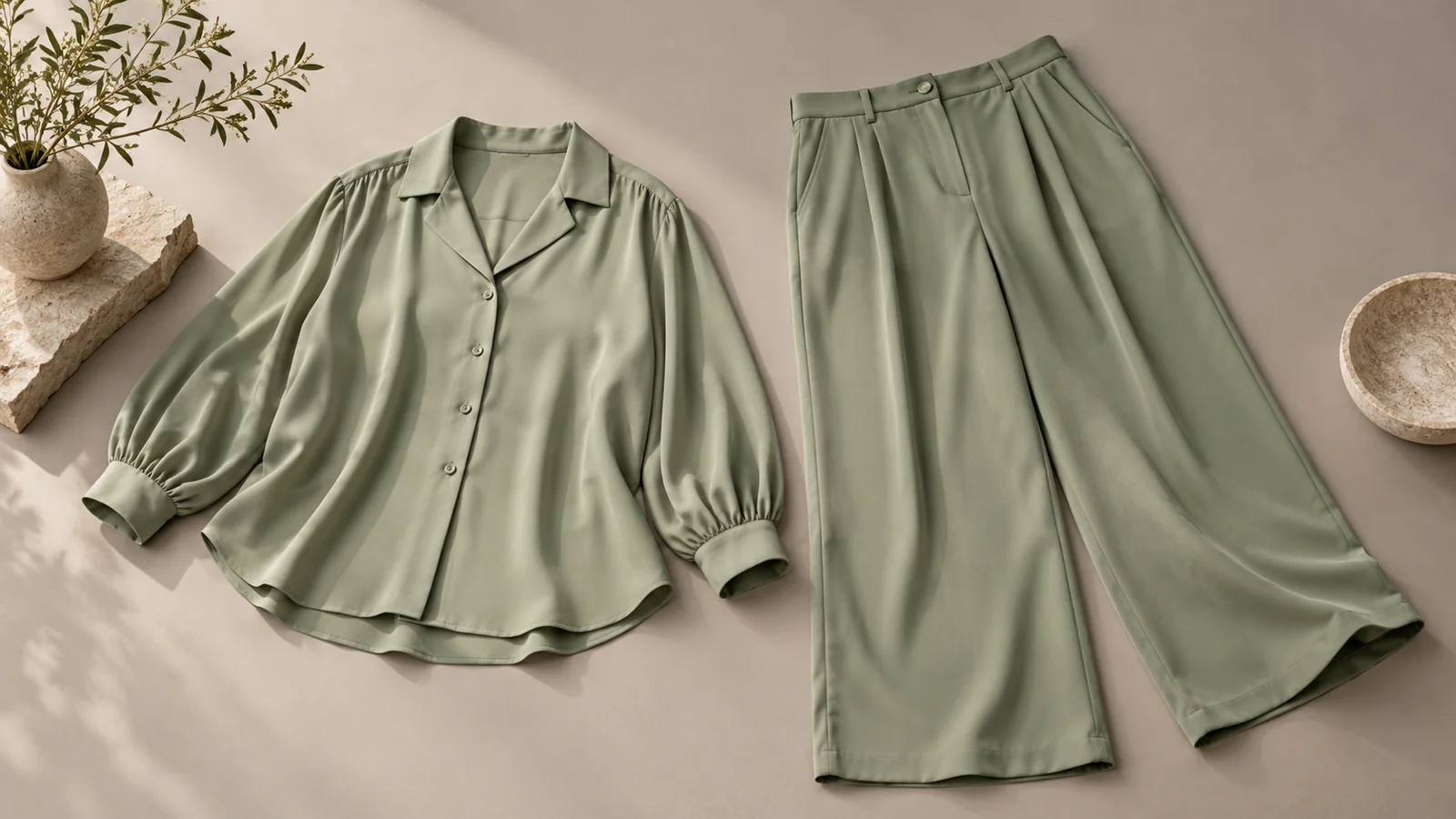
A coordinated outfit can simplify selection and presentation. Independent pieces can accommodate different top and bottom requirements. Neither is inherently more inclusive; the important question is whether the buying and sizing options reflect the intended customer.
Public wardrobe questions such as Reddit: plus-size capsule wardrobe question can prompt useful research about mixed sizing, but cannot tell a buyer how common the need is. Ask your own audience and retail partners rather than turning one discussion into a market percentage.
Separate fit approval for each garment
The top and bottom need their own specifications and relevant movement review. A visually balanced outfit does not establish that both pieces work on the same size reference. Record how the proposed set sizes are mapped and what alternatives are allowed.
If customers can mix sizes, ensure the order and packing system can support it. A flexible sales promise without clear picking rules can create fulfilment errors even when the garments themselves are correct.
Model the inventory relationship
A fixed set links the sale of two items. If demand for the top and bottom differs, the buyer may hold uneven stock. Separates allow independent replenishment but require more deliberate merchandising and coordination of colour continuity.
Use hypothetical scenarios rather than invented sales forecasts. Ask what happens if one piece sells twice as quickly, a colour is delayed or a size is unavailable. The point is to expose the dependency, not predict a universal ratio.
Clarify commercial and packing units
Ask whether a quotation is per set or per piece, what components are included and how the minimum applies. FORMIVA’s catalogue MOQ is 100+ pcs; custom OEM/ODM MOQ is 150+ pcs; do not reinterpret that as 100 sets or a permitted mix without agreement.
Packing instructions should identify the style and size of each component. If sold together, define how the pair is associated. If sold separately, make sure the labels and product information do not imply that the other garment is included.
Choose a manageable launch structure
A new brand may prefer a narrow coordinated capsule with clearly defined combinations. An established retailer with category data may support more independent options. Review your operational capacity alongside the styling opportunity.
Retain flexibility where it serves a documented customer need, but do not add combinations merely to make the assortment look larger. A clear size choice, accurate imagery and feasible replenishment are more valuable than a complicated offer the warehouse cannot execute.
Decide how customers can buy and fit the pieces
A coordinated appearance does not require a fixed selling unit. Ask whether the intended customer can choose different top and bottom sizes, and whether the sales channel supports that choice. A fixed set can simplify one part of merchandising while making size relationships more restrictive. Separates can offer flexibility but require their own allocation and presentation decisions.
Define the quotation unit clearly. Two garments sold together are not necessarily counted the same way by every supplier. State whether quantities refer to sets or individual pieces, and identify how labels and packaging should reflect the arrangement. A misunderstanding here can distort both cost comparisons and order totals.
Review the pieces individually and together. Colour appearance, proportion and material behaviour should support the intended coordination. If a top and bottom use different fabrics, do not assume a shared colour name guarantees a visual match under relevant lighting.
Model the inventory consequence before committing
For a hypothetical launch, compare a fixed-set plan with a separates plan using explicit assumptions about top and bottom demand. Do not invent a universal ratio. Consider what happens if one piece sells more quickly or if customers prefer different size combinations. The exercise reveals operational questions even when the buyer lacks reliable forecasting data.
Ask how replenishment would work for each piece and whether material continuity can be supported. A remaining top may be harder to sell if its matching bottom is unavailable, but ordering too many replacements can create a new imbalance. Clarify options without assuming that every small repeat is possible.
Choose the selling approach that fits the channel and customer brief, then document it in the order. If the buyer later changes from sets to separates, revisit labeling, packing, pricing and product information rather than treating it as a purely visual merchandising change.
Decision checklist
| Decision | Fixed set | Separates |
|---|---|---|
| Sizing | Defined paired sizes | Independent selection |
| Inventory | Linked demand | Separate replenishment |
| Packing | Association of two pieces | Clear individual identifiers |
| Communication | State what is included | Avoid implying a complete outfit |
Frequently asked questions
Must the top and bottom use the same label size?
No, but the chosen pairing or mix-and-match system must be explicit and operationally feasible.
Are sets always cheaper to buy?
Not necessarily; compare the complete unit and included components.
Can I replenish only the trousers?
Confirm material continuity and applicable minimums for that component.
Should a set photograph show both pieces?
Yes, and the text must clearly state whether the pictured pieces are included or sold separately.
Sources & scope
- Reddit: plus-size capsule wardrobe question
One self-selected discussion used to discover a question, not prevalence, sales or representative demand. Source date: 2026-01-18. Checked 23 October 2026.
Your next step
Review co-ord and separate options →For your collection, confirm the style’s size chart and specifications. S–8XL is an overall development range, not a US size conversion.
Browse styles · Development services